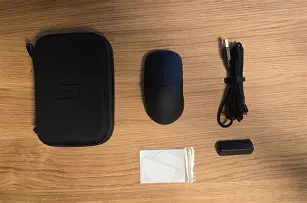
Why Everyone is Buying the Xm2W 4K (Full Review)
I remember the specific moment I decided to pull the trigger on the Xm2W 4K. It was about four months ago, and I was staring at my desk, frustrated by the clutter of wires and the perceptible input lag from my previous "flagship" wireless mouse. In the competitive peripheral market, there is often a lot of noise about polling rates and sensor technicalities, but as someone who spends upwards of ten hours a day with my hand on a mouse—half for high-level creative work and half for gaming—I needed something that actually translated those specs into a tangible difference I could feel. After hearing the growing buzz in enthusiast circles, I finally picked one up. Since then, I’ve put it through hundreds of hours of use, and while it isn’t perfect, I finally understand why this specific unit has become the darling of the hardware community.
The First Impression: Breaking the Lightweight Myth
When I first unboxed the Xm2W 4K, I was immediately struck by the coating. In my experience, most lightweight mice tend to feel like cheap, hollow plastic. They creak when you squeeze them, or the plastic feels slightly "chalky." The first thing I noticed when I held this mouse was that it felt incredibly dense and structural, despite only weighing around 63 grams. I’ve been using it for several months now, and that initial sense of build quality hasn't faded. There is no side-wall flex, which is a common issue I’ve had with other honeycomb-style or ultra-light shells. It feels like a solid piece of stone that happens to weigh almost nothing.
The shape is what really gripped me—literally. I’m a claw-grip user, and I’ve found that many modern mice are moving toward a very safe, symmetrical "potato" shape that doesn't offer much for the palm to anchor onto. The Xm2W 4K has these aggressive inward curves on the sides and a pronounced rear hump. After testing for a week, I realized that these curves let me "lock" my fingers in place far better than the flatter sides of the G Pro or the Viper. It felt like the mouse was an extension of my arm rather than a tool I was trying to hold onto.
Living with 4K Polling: Hype vs. Reality
The "4K" in the name refers to the 4000Hz polling rate. Most mice report their position to your computer 1000 times per second. This one does it 4000 times. I’ll be honest: I was skeptical. I thought this was just marketing fluff designed to drain the battery faster. However, after using it for a month on a 240Hz monitor, I noticed that the cursor movement felt "thicker" and more fluid. It’s hard to describe accurately, but what I found was that the jittery micro-movements I used to see when slowly tracking a target in a shooter or making a precise crop in Photoshop were gone. Everything felt more granular and responsive.
However, there is a trade-off I noticed that many reviewers gloss over. Using 4K polling genuinely hits your CPU harder. On my older laptop, I actually saw a slight dip in frame rates in high-motion games because the processor was working overtime to handle the mouse data. On my main desktop, it wasn't an issue, but it’s something to consider. In my experience, the benefit of 4K is only truly visible if you have a high-refresh-rate monitor (144Hz or higher). If you're on a standard 60Hz office screen, you likely won't feel the difference that الجميع (everyone) is talking about.
The Switches and the "Click" Experience
One thing that bothered me about my previous wireless mice was the "mushy" feeling that develops over time. The Xm2W 4K uses optical switches for its main buttons. Because there is no physical contact point that can degrade or double-click accidentally, the click feel is incredibly consistent. After four months, the left and right clicks feel exactly as they did on day one—crisp, tactile, and surprisingly loud. They have a certain "snap" to them that communicates exactly when the actuation happens. I was surprised by how much I grew to appreciate this feedback during intense sessions; I never had to wonder if a click registered.
The scroll wheel, however, gave me mixed feelings. I noticed that the steps are very defined, which is great for switching weapons in a game without over-scrolling. But for long-form reading or scrolling through massive spreadsheets, I found it a bit too tactile and "notchy." It requires more force to move than I’m used to, and after a long day of work, my index finger actually felt a bit fatigued from the resistance. It’s clearly tuned for gaming precision over productivity comfort.
Looking for the best Electronics deals on Amazon?
Browse Now →Battery Life: The Practical Reality
Battery life is where the 4K reality sets in. When I set the mouse to 1000Hz (the standard rate), the battery lasted me nearly two weeks of heavy use. When I bumped it up to the full 4000Hz, I was charging it every three to four days. It’s a significant delta. I eventually settled on a "hybrid" approach: I use a profile that switches to 4K for my gaming applications and drops back to 1000Hz for my browser and work apps. This managed to stretch the battery to about a week. One thing I appreciated was the charging cable—it’s a soft, flexible paracord-style cable that didn't feel restrictive when I had to use the mouse while it was plugged in.
The Software and Customization
I’ve always hated bloated peripheral software that requires an account and eats up RAM in the background. I was pleasantly surprised to find that the Xm2W 4K software is a lightweight, standalone utility. You open it, change your DPI, polling rate, and lift-off distance, save it to the on-board memory, and then you can delete the software if you want. This is a huge win for me. I hate having "Live Services" for a mouse. I found the "Motion Sync" toggle particularly interesting—it synchronizes the mouse sensor data with the laptop's polling intervals. Turning this on made the mouse feel even smoother, though I did notice it adds a tiny, almost imperceptible amount of input latency (around 0.5ms), so I kept it off for competitive play.
Comparison with Competitors
To give some context on why this mouse stands out, I’ve put together a small comparison of how it felt against the other "heavy hitters" I’ve used in the last year.
| Feature | Xm2W 4K | Brand G Pro X2 | Brand R Viper V3 |
|---|---|---|---|
| Weight | 63g | 60g | 54g |
| Switch Type | Optical (Crisp) | Hybrid (Firm) | Optical (Light) |
| Max Polling | 4000Hz | 2000Hz | 8000Hz |
| Coating Grip | Excellent (Chalky-smooth) | Average (Slippery) | Good (Textured) |
| Shape Intent | Aggressive Claw | Safe Symmetrical | Flatter Performance |
What I Didn't Like: The Honest Cons
It wouldn't be a real review if I didn't mention the frustrations. One thing that disappointed me was the side buttons. Compared to the main clicks, which are world-class, the side buttons feel a bit "thin" and have a lot of post-travel. When I press the back button with my thumb, it feels like the plastic is bending into the shell slightly more than it should. It hasn't broken, but it lacks that premium "snap" found on the top of the mouse.
I also noticed that the coating, while amazing for grip, is a fingerprint magnet. If you have even slightly oily skin, the mouse starts looking "shiny" within a couple of days. I’ve found myself wiping it down with a microfiber cloth every other night just to keep it looking clean. It’s a minor aesthetic gripe, but when you spend this much on a peripheral, you want it to look the part on your desk.
Pros and Cons Analysis
- Pros:
- Unrivaled structural integrity; the mouse feels indestructible despite the low weight.
- The shape provides the best "locked-in" feeling for claw and fingertip grip users I've ever experienced.
- Optical switches eliminate double-clicking issues and provide a very satisfying tactile response.
- Lightweight software that doesn't track your data or require a login to function.
- The 4K polling rate provides a noticeable upgrade in smoothness on high-refresh-rate displays.
- Cons:
- Battery life drops significantly when using 4000Hz polling mode.
- The coating shows skin oils and fingerprints very easily, requiring frequent cleaning.
- Side buttons feel slightly "mushy" compared to the excellent primary clicks.
- The scroll wheel resistance might be too high for users who do a lot of office work or browsing.
Buying Guide: Is the Xm2W 4K for You?
Deciding whether to buy this mouse comes down to three factors: your grip style, your monitor, and your patience with charging. If you are a palm-grip user with very large hands, you might find the rear hump of the Xm2W 4K a bit too intrusive, as it really wants to sit against the base of your thumb. However, if you use a claw or relaxed-claw grip, this is arguably the best shape currently on the market. Better shapes lead to better aim and less fatigue, which I definitely experienced.
Looking for the best Electronics deals on Amazon?
Shop Amazon →Secondly, consider your screen. If you are gaming on a 60Hz or even a 120Hz monitor, the 4K polling rate is mostly a vanity spec. You won't see the benefit, and you'll just be charging the mouse more often. But if you have a 240Hz or 360Hz panel, the Xm2W 4K is one of the few devices that actually lets that screen "breathe" by providing a high enough resolution of movement data to keep up with the refresh rate.
Lastly, pay attention to the surface you use. I tested this on both a glass pad and a standard cloth pad. In my experience, it performed significantly better on cloth. The stock PTFE feet are quite small and rounded, which felt a bit "skating-on-ice" on glass. On a high-quality cloth pad, the control was perfect. I was surprised by how much the foot design influenced the "stopping power" of the mouse during quick flick shots.
Long-term Durability and Final Thoughts
After four months of daily abuse—including being tossed into my backpack for travel—the Xm2W 4K has held up remarkably well. There are no rattles, no loose components inside, and the sensor hasn't spun out a single time. I’ve dropped it once from desk height (about 30 inches) onto a hardwood floor, and while my heart stopped for a second, the mouse didn't even have a scuff on it. This level of durability in the "ultra-light" category is rare.
What I found during my time with this mouse is that it isn't just about the specs. Yes, the 4K polling is great, and the sensor is top-tier (3395 sensor), but those are just numbers on a box. What actually makes this mouse worth the hype is the intentionality of the design. Every curve on the shell feels like it was placed there for a reason, and every click feels like it was tuned to provide specific feedback. It moves the conversation away from "how light can we make it" toward "how good can we make it feel while keeping it light."
In conclusion, the Xm2W 4K feels like a "grown-up" gaming mouse. It lacks the flashy RGB lighting and the over-the-top branding of some competitors, but it replaces those with raw performance and structural reliability. It’s been a staple on my desk for months, and even though the battery life in 4K mode is a bit of a nuisance, the sheer confidence it gives me in fast-paced tasks makes it impossible for me to go back to a standard 1000Hz mouse. If you can handle the fingerprints and the frequent charging, you’ll find one of the most precise and satisfying tools for your hand that has been released in years. It’s one of the few times where the community excitement actually matches the reality of the hardware.